A couple went shopping at the mall.
They decided to go their separate ways when the husband realized his wife was gone for several hours and didn't meet him at their appointed meeting place.
Tired of looking for her, he decided to sit by a beautiful blonde on the mall bench.
He smiled and offered to light her cigarette and said, "Talk to me...Quick!!!"
She said, "Why?"
"Because everytime I am talking to a beautiful woman, my wife appears!"

"Into everyone's life, a little rain must fall, but this is ridiculous." - Noah
In a mental institution a nurse walks into a room and sees a patient acting like he's driving a car.
The nurse asks him, "Charlie, what are you doing?"
Charlie replied, "Driving to Chicago!"
The nurse wishes him a good trip and leaves the room.
The next day the nurse enters Charlie's room just as he stops driving his imaginary car and asks, "Well Charlie, how are you doing?"
Charlie says, "I just got into Chicago"
"Great," replied the nurse.
The nurse leaves Charlie's room and goes across the hall into Bob's room, and finds Bob sitting on his bed furiously masturbating.
Shocked, she asks, "Bob, what are you doing?!"
Bob says, "I'm screwing Charlie's wife while he's in Chicago!"

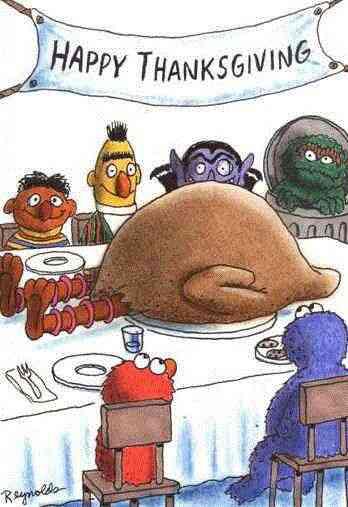
There is a factory in Northern Minnesota which makes the Tickle Me Elmo toys.
The toy laughs when you tickle it under the arms.
Well, Lena is hired at The Tickle Me Elmo Factory and she reports for her first day promptly at 0800.
The next day at 0845 there is a knock at the Personnel Manager's door.
The Foreman throws open the door and begins to rant about the new employee.
He complains that she is incredibly slow and the whole line is backing up, putting the entire production line behind schedule.
The Personnel Manager decides he should see this for himself, so the 2 men march down to the factory floor.
When they get there the line is so backed up that there are Tickle Me Elmos all over the factory floor and they're really beginning to pile up.
At the end of the line stands Lena surrounded by mountains of Tickle Me Elmos.
She has a roll of plush red fabric and a huge bag of small marbles.
The 2 men watch in amazement as she cuts a little piece of fabric, wraps it around two marbles and begins to carefully sew the little package between Elmo's legs.
The Personnel Manager bursts into laughter.
After several minutes of hysterics he pulls himself together and approaches Lena.
"I'm sorry," he says to her, barely able to keep a straight face, but I think you misunderstood the instructions I gave you yesterday ..
"Your job is to give Elmo two test tickles."
While on holiday in Kenya and walking through the bush, a man comes across an elephant standing with one leg raised in the air.
The elephant seems distressed so the man approaches very carefully.
He gets down on one knee and inspects the bottom of the elephants' foot, only to find a large thorn deeply embedded.
Carefully and as gently as he can, he removes the thorn and the elephant gingerly puts its foot down.
The elephant turns to face the man and with a rather stern look on its face, stares at him.
For a good two minutes the man stands frozen, thinking of nothing else but being trampled.
But eventually, the elephant turns and walks away.
For years after, the man often remembers and ponders the events of that day...
Then one day, the man is walking through the zoo with his son.
As they approach the elephant enclosure, one of the elephants turns and walks over to where they are standing at the rail.
It stares at him and the man can't help wondering if this is the same elephant.
The man climbs tentatively over the railing and makes his way into the enclosure.
He walks right up to the elephant and stares back curiously.
Suddenly, the elephant wraps its trunk around one of the man's legs and swings him wildly back and forth along the railing, instantly killing him.
Probably not the same elephant then...
The French will eat almost anything.
A young cook decided that the French would enjoy feasting on rabbits and decided to raise rabbits in Paris and sell them to the finer restaurants in the city.
He searched all over Paris seeking a suitable place to raise his rabbits.
None could be found.
Finally, an old priest at the cathedral said he could have a small area behind the rectory for his rabbits.
He successfully raised a number of them, and when he went about Paris selling them, a restaurant owner asked him where he got such fresh rabbits.
The young man replied, "I raise them myself, near the cathedral. In fact, I have a hutch back of Notre Dame."

One day a five year old little girl excitedly approached her mother, and
announced that she had learned where babies come from.
The mother was amused
and said "Oh really sweetie, why don't you tell me all about it?"
The little girl then explained, "Well...the mommy and daddy take off all of
their clothes, and the daddy's wiener stands way up high, and the mommy
kneels on the floor and puts the daddy's wiener in her mouth, and then the
daddy's wiener sort of explodes and makes sticky juice into the mommy's
mouth, and then the mommy swallows the sticky juice, and that's where babies
come from."
The mother looked lovingly at her daughter, leaned over to meet her eye to
eye and said, "Oh honey, that's sweet, but that's not where babies come
from. That's where jewelry comes from." .
Steve Davis, the world champion snooker player, got married and it was the first night of his honeymoon.
His beautiful wife lay spread across the bed wearing only a scanty silken black nightdress.
Presently Steve came out of the bathroom totally naked with a long stiff erection and walked slowly to the foot of the bed.
He didn't utter a sound but simply stood there looking at her and chalking the end of his erect penis.
This went on for over ten minutes, the only movement being the slow rhythmic chalking of the tip of his penis and the movement of his head from side to side as he stared at her lying on the bed.
Eventually, moist with excitement and shaking with anticipation she tore off her night dress and slowly spread her legs wide open waiting for him to take her.
Steve simply raised his eyebrows, cocked his head to the side and continued to slowly stroke the soft chalk across the glistening, throbbing penis as he stared intensely at the pleasures he saw between her outspread legs.
It was too much for her to stand, writhing in an agony of expectation and frustration she screamed out, "For God's sake what are you waiting for?"
Steve gently stroked the chalk across his throbbing penis, blew the loose chalk off its end, smiled and looking even more closely between her smooth thighs quietly told her, "I'm trying to decide whether to go for the tight brown or the easy pink."

10. You're guaranteed to get at least a little something in the sack.
9. If you get tired, you can wait ten minutes and go at it again.
8. The uglier you look, the easier it is to get some.
7. You don't have to compliment the person who gives you the candy.
6. If you don't get what you want, you can always try another neighborhood.
5. 40 years from now, you'll still enjoy candy.
4. You can swap with your friends.
3. It doesn't matter if the kids hear you moaning and groaning.
2. No one expects you to hang around after you've gotten your candy.
1. You can do the whole neighborhood!
An elderly Jewish man has just moved to a new town, when he is taken ill and decides that he needs to see a doctor.
In the waiting room at the surgery, he tries to find out a bit about the doctor.
He asks the man sitting next to him if the doctor is a specialist.
The man replies that the doctor specializes in everything.
The Jewish man thinks about this and looks nervous.
He asks the man if the doctor's fees are expensive.
The man says: "Well, he is and he isn't. You see, he charges you one thousand dollars for your first visit.
The Jewish man looks even more worried now and exclaims in amazement, "A thousand dollars?"
The man replies, "Yes, but all your visits after that for the rest of your life are free!"
The Jewish man thinks about this, and then gets called by the nurse to go in to see the doctor.
On entering the doctor's office he says casually,
"Hello doctor, here I am again!"
"One of the people has freckles and so he finds somebody else who has
freckles too."
Andrew, age 6
"No one is sure why it happens, but I heard it has something to do with how
you smell ... That's why perfume and deodorant are so popular."
Mae, age 9
"I think you're supposed to get shot with an arrow or something, but the rest
of it isn't supposed to be so painful."
Manuel, age 8
ON WHAT FALLING IN LOVE IS LIKE
"Like an avalanche where you have to run for your life."
John, age 9
"If falling in love is anything like learning how to spell, I don't want
to
do it.It takes too long."
Glenn, age 7
ON THE ROLE OF BEAUTY AND HANDSOMENESS IN LOVE
"If you want to be loved by somebody who isn't already in your family, it
doesn't hurt to be beautiful."
Anita C., age 8
"It isn't always just how you look.Look at me.I'm handsome like anything
and I haven't got anybody to marry me yet."
Brian, age 7
"Beauty is skin deep.But how rich you are can last a long time."
Christine, age 9
REFLECTIONS ON THE NATURE OF LOVE
"Love is the most important thing in the world, but baseball is pretty
good
too."
Greg, age 8
HOW DO PEOPLE IN LOVE TYPICALLY BEHAVE?
"Mooshy ... like puppy dogs ... except puppy dogs don't wag their tails
nearly as much."
Arnold, age 10
"All of a sudden, the people get movie fever so they can sit together in
the
dark."
Sherm, age 8
CONCERNING WHY LOVERS OFTEN HOLD HANDS
"They want to make sure their rings don't fall off because they paid good
money for them."
Gavin, age 8
"They are just practicing for when they might have to walk down the aisle
someday and do the holy matchimony thing."
John, age 9
CONFIDENTIAL OPINIONS ABOUT LOVE
"I'm in favor of love as long as it doesn't happen when 'Dinosaurs' is on
television."
Jill, age 6
"Love is foolish ... but I still might try it sometime."
Floyd, age 9
"Love will find you, even if you are trying to hide from it.I been trying
to hide from it since I was five, but the girls keep finding
me."
Dave, age 8
"I'm not rushing into being in love.I'm finding fourth grade hard enough."
Regina, age 10
THE PERSONAL QUALITIES YOU NEED TO HAVE IN ORDER TO BE A GOOD LOVER
"Sensitivity don't hurt."
Robbie, age 8
"One of you should know how to write a check.Because, even if you have
tons
of love, there is still going to be a lot of bills."
Ava, age 8
SOME SUREFIRE WAYS TO MAKE A PERSON FALL IN LOVE WITH YOU
"Tell them that you own a whole bunch of candy stores."
Del, age 6
"Yell out that you love them at the top of your lungs ... and don't worry
if
their parents are right there."
Manuel, age 8
"Don't do things like have smelly, green sneakers.You might get attention,
but attention ain't the same thing as love."
Alonzo, age 9
"One way is to take the girl out to eat.Make sure it's something she likes
to eat.French fries usually works for me."
Bart, age 9
HOW CAN YOU TELL IF TWO ADULTS EATING DINNER AT A RESTAURANT ARE IN
LOVE?
"Just see if the man picks up the check. That's how you can tell if he's
in
love."
Bobby, age 9
"Lovers will just be staring at each other and their food will get cold
...
Other people care more about the food."
Bart, age 9
"Romantic adults usually are all dressed up, so if they are just wearing
jeans it might mean they used to go out or they just broke up."
Sarah, age 9
"See if the man has lipstick on his face."
Sandra, age 7
"It's love if they order one of those desserts that are on fire.They like
to order those because it's just like how their hearts are --- on fire."
Christine, age 9
TITLES OF THE LOVE BALLADS YOU CAN SING TO YOUR BELOVED
"'How Do I Love Thee When You're Always Picking Your Nose?'"
Arnold, age 10
"'You Are My Darling Even Though You Also Know My Sister.'"
Larry, age 8
"'I Love Hamburgers, I Like You!'"
Eddie, age 6
"'I Am in Love with You Most of the Time, but Don't Bother Me When I'm
with
My Friends.'"
Bob, age 9
"'Hey, Baby, I Don't like Girls but I'm Willing to Forget You Are One!'"
Will, age 7
"The person is thinking: Yeah, I really do love him.But I hope he showers
at least once a day."
Michelle, age 9
"Some lovers might be real nervous, so they are glad that they finally got
it
out and said it and now they can go eat."
Dick, age 7
HOW WAS KISSING INVENTED?
"I know one reason that kissing was created. It makes you feel warm all
over,
and they didn't always have electric heat or fireplaces or even stoves in
their houses."
Gina, age 8
HOW A PERSON LEARNS TO KISS
"You can have a big rehearsal with your Barbie and Ken dolls."
Julia, age 7
"You learn it right on the spot when the gooshy feelings get the best of
you."
Brian, age 7
"It might help to watch soap operas all day."
Carin, age 9
WHEN IS IT OKAY TO KISS SOMEONE?
"When they're rich."
Pam, age 7
"It's never okay to kiss a boy.They always slobber all over you ... That's
why I stopped doing it."
Tammy, age 10
"If it's your mother, you can kiss her anytime.But if it's a new person,
you have to ask permission."
Roger, age 6
"Spend most of your time loving instead of going to work."
Dick, age 7
"Don't forget your wife's name ... That will mess up the love."
Erin, age 8
"Be a good kisser.It might make your wife forget that you never take out
the trash."
Dave, age 8
"Don't say you love somebody and then change your mind ... Love isn't like
picking what movie you want to watch."
Natalie, age 9